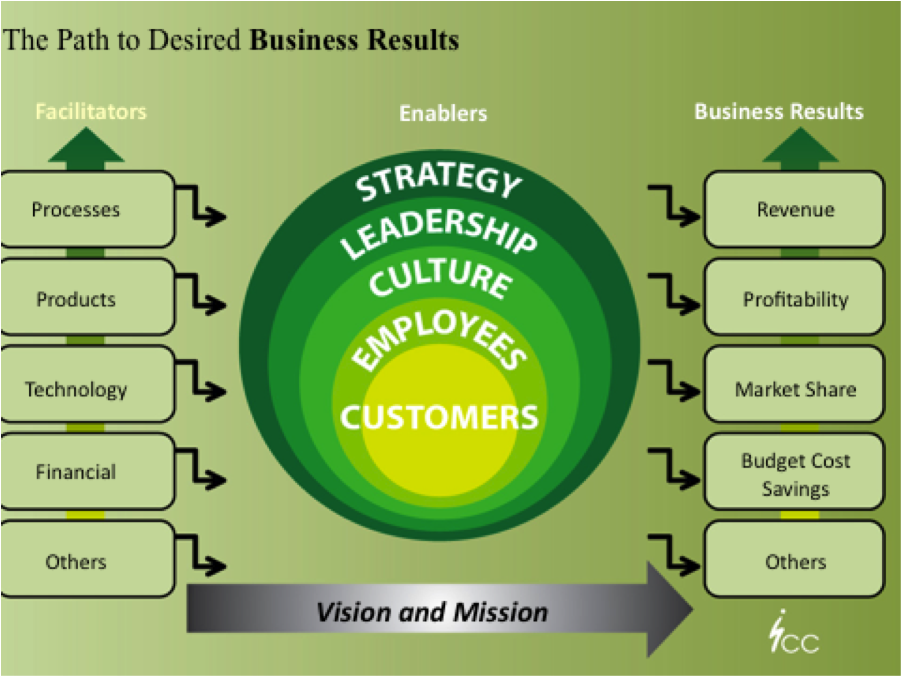

This blog is dedicated to the discussion of engaged companies and how to become engaged for better results. By examining best practices in 5 key areas of the organization: Strategy, Leadership, Culture, Employees and Customer, companies can understand how to successfully and uniquely engage at all levels.


Stephen Sadove is a leader I can follow. The CEO of Saks, Inc. was interviewed by the New York Times recently and was asked about his leadership philosophy. His response was that leadership drives culture, which drives business results. Mr. Sadove went on to say that while Wall Street never asks about leadership, culture or people, they actually are what drive numbers and results. Mr. Sadove, you are my hero.
Trying to define organizational culture is a little like nailing Jell-o to a wall: slippery, messy and just plain hard. But, when a leader understands that the harder- to -grasp organizational elements actually make up the engine that propels results, we are at least half way to having a company that truly is engaged. While many C-Suite occupants are comfortable with spreadsheets and analytics (and no one would argue their essential value), the numbers don’t happen by accident or in a vacuum. It takes a lot of deep searching to arrive at a culture design that supports the results you want.
I recently saw a presentation by Reed Hastings, CEO of Netflix who, while not a fan of process, nevertheless, put the steps for embedding Values, Strategy, Leadership and People into a framework he calls Freedom and Responsibility Culture:
How Do We Define Success? For Netflix, business results are “continuous growth in revenue, profits and reputation”.
How Are We Going to Get There? Hastings defined the strategy as “rapid innovation and excellent execution”.
How Does Our Environment Support Our Strategy? Netflix’s culture specifically supports “effective teamwork of high performing people”.
What Would Jeopardize Our Success? For Reed Hastings, it is a culture that tolerates rigidity, politics, mediocrity and complacency.
From this high level, Netflix is able to articulate how its Values are embedded in its culture and specifically defines behaviors that will be rewarded and those that result in being cut from the team. There is no room for ambiguity in Reed Hastings’ vision of success, which means that employees know exactly what is expected of them (part of a team of high performing people) and how their jobs contribute to the company’s success goals (innovating and executing).
We are in an environment today which demands that we stand out in every way. To ignore organizational culture is to sabotage your business success.
Can you answer the four questions above for your company? Can your employees?
The Gulf oilrig explosion and its aftermath is an example of how what we do (or fail to do) impacts others we don’t know in ways we haven’t even considered. Did the relentless push to drill, baby, drill faster to save money and to get the oil (revenue) flowing as quickly as possible compromise BP’s values? Lives have been lost; livelihoods are endangered; ecosystems and economies may never recover. Even my condo in Hilton Head has seen an increase in rentals because vacationers don’t want to risk a holiday on the Gulf coast. The ripple effect will be felt globally through many channels in very quantifiable ways.
We are so intertwined and so connected, thanks to technology and the Internet; we are so darned global that more of us have the power to impact other people’s lives than ever. So, how we behave; how we treat others and how we build trust with employees and customers have an exponential impact on them, on others we can’t even identify and on our own businesses.
Leaders: this is where you come in.
The CEO of BP can hug all the fisherman in Louisiana he wants but if he put profit before ethical behavior (by short circuiting safety for example), what does that say to his employees in terms of their own behaviors? How should customers react? What has this done to BP’s prized Brand? Judging by recent loyalty scores for Toyota, for example, customers and would-be buyers take time to recover when confidence is shaken.
BP’s Values are Progressive, Responsible, Innovative and Performance-driven. It looks good on a web site but do they influence behaviors and decisions? Time will tell and the whole world will be judging.
As a leader, Tony Hayward needs to demonstrate how he and his company will rise above PR, litigation and playing the blame game to behave in a way that inspires confidence and trust. That behavior will ricochet around the world in social media channels and news outlets as fast as the bad news is traveling. His recent performance on Capital Hill suggests that this is not a lesson Mr. Hayward has learned yet.
Dov Seidman, author of the book, How, says that we all now live in the “Era of Behavior”. He argues that too many of us are behaving by situational values or whatever the situation allows. Sustainable values on the other hand inspire us to do what should be done in every situation; they strengthen relationships for the long-term and reinforce our reputation in the global networks that drive our brand performance.
If how we behave doesn't match what we say on web sites, in annual reports or corporate communications, how successful do you think we will be with issues like employee engagement, customer commitment or organizational culture change? Behavior matters. End of story.

Ah, those halcyon days when companies owned the customer relationship and decided what the buyer needed to know and when she needed to know it. When advertising on television or in newspapers were the only way to capture the attention of a rapt audience. We built it, however indifferently, and they came.
Well, that was then and here we are now. I came across again a great book published ten years ago, titled “The Cluetrain Manifesto” and its preamble struck me as more true now than when it was first published. “We are not seats or eyeballs or end users or consumers. We are human beings – and our reach exceeds our grasp. Deal with it.”
In thinking about how our companies can change the conversation with customers, I believe it’s the whole company that engages and creates the moments of truth. Frankly it amazes me that I can still come across stories as I did last weekend in the New York Times about the complete failure of a major airline to deal effectively with a reasonable request for a refund. It wasn’t just the unbelievably difficult voice mail navigation or the lack of a human to speak with or the conflicting information provided by different departments but also the arrogance of a senior employee who blamed the customer for not being able discern the difference between a Customer Refund Department and a Customer Relations Department (huh??). Oh yes, we still hold our customers hostage, but those opportunities are fewer and the more often these stories are repeated online and the dinosaur company that still doesn’t get it is named, the more the customer manifesto gains strength. Did this story just make you sit up? Remind you of your own company? Uh oh.
Here are a few thoughts in the context of engaging the whole company to create effective human networks:
Strategy: How do you define your market? It’s a human network of conversations that are smarter and more informed than ever. If you aren’t providing information and support, your markets are finding it among themselves and making you irrelevant.
Leadership: Are you having a conversation with your markets or providing talking points, corporate communications and PR? Markets can move quickly – away from you.
Culture: is it command and control you seek or hands on knowledge and respect?
Employees: This group is remarkably like your markets because they, too, are human beings who want information, support and conversations. Are you building networks for them to have meaningful exchanges? If you think your intranet fulfills this requirement, look at it again. Or, read about what Proctor and Gamble did to build its very successful networks for employees and customers.
Customers: They have a voice and they want to use it. You have a voice and they want to hear it. Not in brochures or web sites that have no substance. Not in the scripted “dialogue” with your call center. As the Manifesto summed it up, “You want us to pay? We want you to pay attention.”
We can invest in all the technology and processes our CFO will allow but if we don’t build in the human desire for connection and conversation, we will be talking to ourselves.

I read an interview the other day with the CEO of a major retailer who talked extensively about the impact of the company's values, called Foundation Principles, on how the company is run. I consult with clients on strategy, so I'm interested in companies that 1) have actually thought about their Values; 2) have articulated them; and 3) lead by them. Values can be the compass that guides business decisions, large and small and in my view are necessary precursors of a well designed strategy.
When a company blunders, as JetBlue did on Valentine's Day 2007 at JFK Airport in New York, when thousands of passengers were stranded for hours aboard planes, one course of action that has become popular is to not respond to the incident at all or respond only if pressed and, if at all possible, pass the blame to someone else. Instead, JetBlue took responsibility and created its Passenger Bills of Rights. Its founder and CEO paid the ultimate price with his job. But, dig a little deeper, as the article outlined, and you'll discover that JetBlue took a systematic view of the problems and, rather than engage in a short-term PR exercise, overhauled the way employees and customers viewed the company, for the long-term.
JetBlue's strategy is to differentiate itself through a customer-and employee-centric culture. Leadership would not tolerate any declines in employee or customer perceptions of the airline as a good place to work or a good flying experience. The changes started with a plan for improving employee engagement results as the thinking was, if the company improved those metrics, customers would receive great experiences (what we call the Spillover Effect).
What the JetBlue executives learned was:
Leaders make mistakes; it's how you recover from them that people remember. The core elements of the business are interdependent and should be viewed that way because they impact your results in a big way.
What drives engagement at JetBlue isn't necessarily what drives engagement in your organization. What are your engagement drivers?


Whether you are Team Conan or Team Leno, playing out a dysfunctional company battle in public shines a light on the role of leadership and strategy in a situation like this. As long as we are being asked to be voyeurs, maybe there are some lessons to be learned and applied in our own organizations.
I was in London for New Year's Eve, watching the fireworks over the Thames with Big Ben tolling and the London Eye outlined in brilliant colors. There was a palpable "something" that rippled through the crowd as we watched the end of one decade and the dawn of a new one. Maybe it was a sigh of relief or an inhale that signaled expectation. Did you feel it too?I'd like to know from you: How are you creating success in 2010? What is your company doing to proactively respond to the shifting mood of the country? Do you have a strategy? What are some of your predictions for 2010?