Showing posts with label business analytics. Show all posts

Wednesday, March 30, 2011

What Do You Want From Your Data? Five Must-Have's


In a recent post, I wrote about the pitfalls of taking your data at face value and last week, I blogged about not knowing the true impact of critical organizational attributes without diving more deeply into the data (read: do more than explore it visually or look at up/down trends).

My business partner sent me an excellent article this morning by Stacy Harris that asks the question: Are You Considering Firing Your Employee Engagement Partner? I’ve been thinking a lot lately about data and how to make sense of it and I recommend this article for anyone else on a data journey. I think Stacy’s research applies to any type of data collection method. I’m summarizing what I took away from the article:

It’s not enough to have a survey; you need a strategy. A stand-alone survey gives you just that: one view whereas designing a survey that supports a business strategy provides data that can be aggregated with other data sets for a more accurate and complete picture.

If you ask generic questions, you get smiley or frown-y answers but no insight. Whether you have 12 questions or 40, if they don’t speak to your culture, your workforce or your targeted customers, I’m hard pressed to see how you will get any “aha’s” that are worth the time and expense of a survey.

What specifically do you want from a survey or any “listening post” that you design? “Because we’ve always done one” or “Because everyone else does it” are not specific objectives. What business issue do you hope to resolve? What’s keeping you or your boss up at night?

How are you analyzing the data? Scores alone may not tell you what you need to know. Trends without relationship to some rationale are just up or down points on a chart. Desktop tools exist to assist. Help is available (call me).

If you’re hung up on benchmarks, you may never get to the “why” of your own project. I know that some organizations swear by a benchmark study and who can argue, as long as the benchmarks map precisely to your own situation and as long as it’s not your only measure. Like generic questions, without the appropriate construct, a benchmark exercise can leave you with no specific roadmap for your success.

Collecting data is a critical component of every function these days. It's a project like any other, with objectives, outcomes and measures. Is your data giving you what you need?


Wednesday, March 23, 2011

Do Scores Matter if You Don't Know What is Critical to Your Customers?


Last week, I wrote about the importance of knowing what drives customer dissatisfaction, which dealt with data interpretation and the need to dive more deeply into the business issues as well as the data.

There are exploratory ways to interpret data and more analytical methods as well. The key to correct interpretation is knowing which approach will deliver insights to your business. As I said in my last post, coming to the wrong conclusions even with good data is a possibility without using the right tools. In the case of customer loyalty, you could be investing in programs that have little or no impact on the customer’s intention to buy again or you could be ignoring “dissatisfiers” that diminish a customer’s perception of your critical attributes.

So, there are a few initial questions to ask:

  • What do you believe are the attributes that contribute to your customers’ loyalty?
  • Are you measuring those attributes specifically in any data gathering exercise including social media monitoring?
  • Do you classify these attributes in terms of their impact on the customer or importance?

The example below is from an article titled Guests’ Perceptions on Factors Influencing Customer Loyalty, which appeared in the March 2010 issue of the International Journal of Contemporary Hospitality Management.

Customer Service : Dissatisfier
Cleanliness : Neutral
Room quality : Dissatisfier
Value for money : Critical
Quality of food : Dissatisfier
Family friendliness : Neutral

The authors selected typical product and service attributes for a guest at a hotel and designed questions around those.
Using simple regression, they did something very interesting and in my view very revealing about the data they collected. The usual loyalty question was asked (intention to return) and all other questions were tested against this one. Then, questions above a median score were tested individually and those below the median also were tested in the same way. The results were plotted against agreed criteria from Critical to Neutral.

Critical Attributes were significant in both tests and would be considered a driver of loyalty as well as a reason to switch. These have high compliments and high complaints. Performing well in other areas won't compensate for low performance here.

Dissatisfiers were significant in testing low performance but not when high performance was tested. So, if customer service is bad, it influences a decision to switch but an average experience doesn’t critically drive loyalty. These are the attributes that should be maintained but not at the expense of more critical ones.

Neutrals generally may not be noticed by customers and although bad performance would reduce perceptions of quality, it would not be to the point where quality is considered poor.


There are some lessons to be learned, I think, from this type of data interpretation:

  • Simple statistical tests are used in a way to deliver insight that would be difficult to obtain with exploring low and high scores alone.
  • Knowing whether a key attribute delivers the loyalty factor; whether it has no affect or whether it destroys loyalty is so valuable in terms of designing the customer experience and making the right investments.
  • This is the kind of "I know" insight that is compelling when reporting on Voice of the Customer issues.
How are you measuring customer loyalty? Do you know what is critical; which areas need only a minimum performance to maintain loyalty and which attributes have no impact on loyalty at all?

Tuesday, February 22, 2011

"Even the Longest Journey Must Begin Where You Stand"


The quote is from Lau Tzu, the Chinese philosopher-turned-management-guru -- and I like it for a couple of reasons. First, it’s so true: you have to honestly appraise your current situation in order to reach any goal. Secondly, no matter how bold your strategy, you can’t obfuscate the situation, thinking that strategy only needs to be stated to be accomplished. As any successful person will tell you, there’s a lot of sweat equity that has to be paid between where you stand and the journey you take.

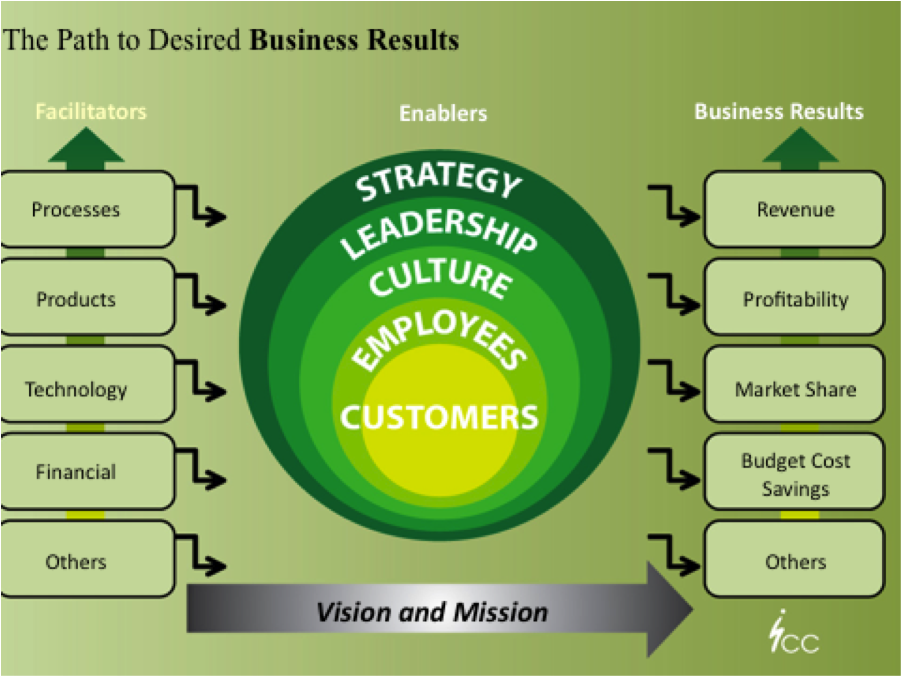
As you probably know by now, I’m fascinated by data and passionate about analytics and how both will transform our businesses. However, it’s a journey not a sprint and begins with assessing what we call "the path to desired business results":


There are five key drivers of performance in any organization and while analytics might be the means to an end, these enablers are the catalysts. So, standing where you are now, it’s worthwhile asking the following questions:

Strategy: How will analytics help us compete successfully? Will we be able to differentiate ourselves in our markets using analytics?

Leadership: Are we as leaders prepared to commit the organization to an analytics based way of making decisions? Can we give the employees who will have to make this work the buy-in they need to be successful? Can we put aside our impatience and allow them to Think Big but Start Small?

Culture: Do we have data fiefdoms that refuse to share data or collaborate on projects? Do we celebrate the efforts of the early adopters, even if success isn’t guaranteed every time, in the spirit of discovery and experimentation? Analytics is all about experiments, testing, and doing it over and over. Have we made more of our decisions by the seat of the pants and been proud of it?

Employees: Do we want analytics to cascade down into the organization and, if so, are we prepared to properly train those whose jobs it will be to manage the technology that supports their business knowledge? Are we hiring employees for competencies that underpin the need for a broadly based analytics movement?

Customers: This is one area of most businesses that has received the most analytics attention so the questions here are: is our customer data in one place, is it at the lowest level of analysis possible and have we aggregated it across all of our channels?

The analytics journey is probably never ending as technology and competencies improve exponentially to deliver more insight with less complexity. But, knowing where you stand before you take the first step – or flying leap – will ensure that this critical initiative doesn’t crash and burn at the first turn in the road.

What is your analytics journey like? Are you looking first at where you stand or sprinting off for the unknown?